

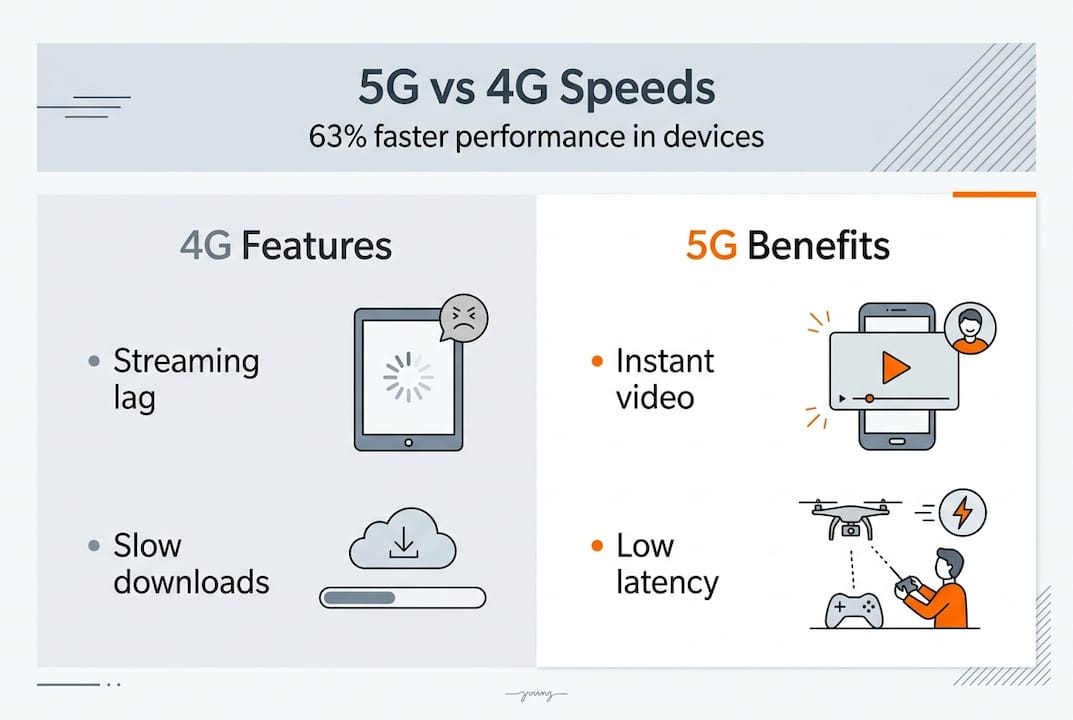
5G in consumer electronics: 63% faster speeds explained
The rollout of 5G networks across Europe has sparked both excitement and confusion among consumers eager to understand its real impact on their devices. While many associate 5G solely with faster internet on smartphones, its influence extends far deeper into how consumer electronics function, communicate, and deliver value in daily life. This article clarifies exactly how 5G transforms device performance, which product categories benefit most, what challenges you might face, and how to maximize these advancements in your connected home and mobile experiences.
Table of Contents
- Key takeaways
- How 5G technology enhances the performance of consumer electronics
- The evolving landscape of 5G-powered consumer electronics
- Challenges and considerations for consumers choosing 5G consumer electronics
- Maximizing the benefits: how to apply 5G advancements in daily consumer electronics use
- Explore top 5G consumer electronics at OnlineStore24
- Frequently asked questions about 5G in consumer electronics
Key Takeaways
| Point | Details |
|---|---|
| Faster and more responsive devices | Ultra low latency and enhanced mobile broadband enable near instant interactions and higher quality media across smartphones, TVs, VR, and wearables. |
| Network slicing benefits | Virtual networks tailor resources for gaming, cameras, and sensors to prevent bottlenecks. |
| Categories benefiting now | Smartphones, smart TVs, VR, IoT, wearables, and connected cars gain immediate performance and new capabilities. |
| European adoption drives innovation | Growing consumer demand across Europe accelerates 5G enabled devices and smart home products. |
How 5G technology enhances the performance of consumer electronics
The fifth generation of wireless technology introduces three critical capabilities that fundamentally change how your devices operate. Ultra-low latency reduces response times to nearly instantaneous levels, enhanced mobile broadband multiplies data transfer speeds, and massive machine-type communications allow thousands of devices to connect simultaneously without degradation. These aren’t just incremental improvements over 4G. They represent a qualitative shift in what your electronics can accomplish.
Consider practical applications. 5G significantly improves communication speed and reduces latency compared to 4G, enabling real-time interactions that were previously impossible. Your smartphone downloads a full HD movie in seconds rather than minutes. Your smart TV streams 8K content without buffering. Your VR headset delivers immersive experiences without motion sickness caused by lag. Your video calls display crystal-clear quality even when multiple household members use bandwidth-intensive applications simultaneously.
Network slicing adds another dimension to performance enhancement. This technology creates virtual networks customized for specific device types or applications. Your gaming console gets a low-latency slice optimized for competitive play. Your security cameras receive a reliable slice for continuous monitoring. Your smart refrigerator operates on an efficient slice designed for periodic data transmission. Each device receives exactly the network resources it needs without competing with others.
Multiple device categories benefit immediately from these improvements:
- Smartphones gain faster app performance, superior video quality, and enhanced cloud gaming capabilities
- Smart TVs stream ultra-high-definition content with zero interruptions and support advanced interactive features
- VR and AR headsets deliver seamless experiences with reduced latency critical for immersion and comfort
- IoT devices communicate more reliably, enabling complex automation scenarios across smart homes
- Wearable health monitors transmit real-time data to medical professionals for remote patient care
- Connected vehicles access navigation updates, entertainment streaming, and vehicle-to-infrastructure communications
Pro Tip: When shopping for consumer electronics, prioritize 5G-enabled models even if your area lacks full coverage yet. Network expansion continues rapidly across Europe, and advantages of consumer electronics with 5G capabilities will become increasingly apparent as infrastructure matures. Future-proofing your purchases ensures you benefit immediately when coverage reaches your location.
The evolving landscape of 5G-powered consumer electronics
Manufacturers are redesigning entire product categories around 5G capabilities, creating devices that simply weren’t feasible with previous wireless generations. Smartphones now integrate advanced computational photography that processes images in the cloud instantly. Tablets function as professional creative tools with real-time collaboration features. Smart home hubs orchestrate complex automation scenarios involving dozens of connected devices without performance bottlenecks.

European consumers increasingly adopt 5G smart devices, driving innovation in connected home products and wearables. This adoption creates a positive feedback loop where increased demand encourages manufacturers to develop more sophisticated 5G-enabled products, which in turn attracts more consumers to upgrade their electronics. The European market’s emphasis on privacy and energy efficiency also shapes how these products evolve, with manufacturers incorporating features that address regional preferences.
Compare how 5G transforms key device features:
| Device Category | 4G Capability | 5G Enhancement |
|---|---|---|
| Smartphones | HD video streaming, basic cloud sync | 8K streaming, instant cloud gaming, real-time AR applications |
| Smart Home Hubs | Controls 10-20 devices with occasional delays | Manages 100+ devices simultaneously with instant response |
| Wearable Health Devices | Periodic data uploads, limited real-time features | Continuous monitoring with immediate alerts and remote consultations |
| Security Cameras | Compressed video, delayed notifications | Full 4K streams, AI-powered instant threat detection |
| Gaming Consoles | Local processing only, download delays | Cloud gaming at console quality, instant multiplayer synchronization |
Faster networks enable entirely new application categories. Augmented reality shopping lets you visualize furniture in your home before purchasing. Remote health monitoring allows doctors to track patient vitals continuously and intervene immediately when concerning patterns emerge. Cloud-based productivity tools provide desktop-class performance on lightweight mobile devices. Multi-angle sports streaming gives you director-level control over your viewing experience.
Emerging device types capitalizing on 5G integration include:
- Holographic displays for immersive communication and entertainment experiences
- Autonomous home robots with real-time cloud AI processing for complex tasks
- Connected kitchen appliances that coordinate meal preparation across multiple devices
- Advanced fitness equipment providing virtual training with professional coaches in real time
- Educational devices offering interactive learning with remote expert instruction
Regional European trends show particularly strong adoption in urban centers where 5G coverage reaches maturity first. Countries like Germany, France, and the Nordic nations lead in smart devices trending in Europe, with consumers prioritizing electronics for modern homes that integrate seamlessly into connected ecosystems. This geographic variation affects product availability and pricing across the continent.
Challenges and considerations for consumers choosing 5G consumer electronics
While 5G promises substantial benefits, several practical factors deserve careful consideration before investing in new devices. Understanding these challenges helps you make informed purchasing decisions that align with your actual usage patterns and local infrastructure realities.
Key considerations when evaluating 5G consumer electronics:
- Network coverage varies significantly across Europe, with urban areas enjoying robust 5G while rural regions may wait years for comparable infrastructure
- Device costs remain elevated compared to 4G equivalents, though prices decline as technology matures and production scales increase
- Battery life often suffers when devices actively use 5G connectivity, requiring more frequent charging or larger battery capacities
- Compatibility issues arise when mixing 5G devices with older wireless standards in home networks and ecosystems
- Privacy and security concerns intensify as more devices collect and transmit sensitive data continuously over wireless networks
Although 5G coverage is expanding, disparities exist across Europe which affect device performance. A 5G smartphone purchased in Amsterdam delivers dramatically different experiences than the same model used in rural Portugal. Before committing to 5G-enabled electronics, verify actual coverage in locations where you’ll use the devices most frequently. Network maps from carriers provide starting points, but real-world testing reveals true performance.
Common myths deserve clarification. Health concerns about 5G radiation lack scientific foundation, with radio frequencies used falling well within established safety guidelines. Claims that 5G drains batteries instantly are exaggerated; modern devices intelligently switch between network types to optimize power consumption. Fears that 5G requires completely replacing all existing electronics are unfounded; most devices continue functioning perfectly on 4G networks while 5G-capable products coexist seamlessly.
Pro Tip: Check your mobile carrier’s coverage map and read user reviews specific to your city or neighborhood before purchasing 5G devices. Official coverage claims often paint optimistic pictures that don’t reflect real-world performance in buildings, during peak usage times, or in areas with limited infrastructure investment.
“Consumers should balance the exciting possibilities of 5G with practical realities of their local network infrastructure, budget constraints, and actual usage needs. The best 5G device is one that delivers tangible improvements in your daily life, not just impressive specifications on paper.” This perspective from the electronics buying guide Europe 2026 emphasizes value over hype.
Maximizing the benefits: how to apply 5G advancements in daily consumer electronics use
Once you’ve invested in 5G-enabled devices, specific strategies help you extract maximum value from their enhanced capabilities. Simple optimizations and informed usage patterns make the difference between marginal improvements and transformative experiences.
Practical tips for optimizing your 5G devices:
- Enable 5G in device network settings, but configure fallback to 4G in areas with weak coverage to prevent constant searching that drains batteries
- Update all apps and operating systems regularly, as developers continuously optimize software to leverage 5G performance characteristics
- Configure quality settings in streaming apps to take advantage of increased bandwidth for 4K or 8K content when available
- Implement smart home automation routines that capitalize on reduced latency for coordinated device actions across your connected ecosystem
- Schedule large downloads and cloud backups during off-peak hours when 5G networks experience less congestion and deliver peak speeds
- Monitor data usage closely, as faster speeds encourage consumption that can quickly exceed monthly allowances on capped plans
5G-enabled devices can significantly improve smart home responsiveness, streaming quality, and mobile connectivity when properly configured. The difference between default settings and optimized configurations often determines whether 5G feels revolutionary or merely incremental.
Typical performance improvements you can expect:
| Metric | 4G Performance | 5G Performance | Improvement |
|---|---|---|---|
| Download Speed | 50-100 Mbps | 500-1000 Mbps | 10x faster |
| Upload Speed | 10-20 Mbps | 100-300 Mbps | 15x faster |
| Latency | 30-50 ms | 1-10 ms | 75% reduction |
| Device Density | 2,000 per km² | 1,000,000 per km² | 500x capacity |
| Connection Reliability | 99% uptime | 99.9% uptime | Enhanced stability |
Smart home automation leveraging 5G connectivity enables sophisticated scenarios. Your security system detects motion and instantly streams high-definition video to your phone regardless of location. Your thermostat coordinates with weather forecasts, occupancy sensors, and energy pricing to optimize comfort and costs. Your entertainment system synchronizes audio across multiple rooms without the lag that plagued previous wireless standards. Your kitchen appliances share cooking progress to coordinate meal preparation perfectly.
For entertainment devices, 5G unlocks premium experiences. Stream live sports with multiple camera angles you control in real time. Play competitive online games with latency so low that network delays become imperceptible. Experience virtual reality concerts and events with quality approaching in-person attendance. Download entire seasons of shows in seconds for offline viewing during travel.
Mobile and wearable device management requires attention to sustain performance. Disable 5G when unnecessary to preserve battery life during long days away from chargers. Use Wi-Fi for stationary activities like working from home to reserve 5G for truly mobile scenarios. Configure health monitoring devices to transmit data over 5G only when immediate alerts matter, using periodic Wi-Fi syncs for routine information. Balance the convenience of constant connectivity with the practical limitations of current battery technology.
Visit electronics buying guides Europe 2026 for detailed recommendations on specific product categories and usage scenarios that benefit most from 5G capabilities.
Explore top 5G consumer electronics at OnlineStore24
Ready to experience the performance advantages 5G brings to consumer electronics? OnlineStore24 offers a curated selection of devices designed to leverage next-generation connectivity for superior functionality in your home and on the go. Our European warehouses ensure fast delivery across the EU, while our product specialists can help you identify electronics that match your specific needs and local network capabilities.
Discover cutting-edge networking equipment like the Trendnet TEW-821DAP access point that maximizes your 5G home network performance. Explore innovative mobile devices such as TCL graphics tablets and pens that combine powerful hardware with 5G connectivity for professional creative work anywhere. Browse our complete catalog at OnlineStore24 to find the perfect 5G-enabled electronics that transform how you work, play, and manage your connected lifestyle.
Frequently asked questions about 5G in consumer electronics
What distinguishes 5G from previous wireless technologies for devices?
5G delivers speeds up to 100 times faster than 4G, reduces latency to under 10 milliseconds, and supports exponentially more simultaneous device connections. These improvements enable real-time applications, seamless streaming of ultra-high-definition content, and complex smart home ecosystems that previous generations couldn’t support reliably.
How does 5G improve everyday consumer electronics usage?
5G eliminates buffering during video streaming, enables instant cloud access for files and applications, provides lag-free video calling even in groups, and allows smart home devices to respond immediately to commands. Your electronics become more responsive, reliable, and capable of handling demanding tasks that previously required wired connections or local processing power.
Are all consumer electronics compatible with 5G networks?
No, devices require specific 5G modems and antennas to access these networks. Older electronics continue functioning on 4G and earlier standards, but cannot utilize 5G capabilities. When purchasing new devices, check specifications explicitly for 5G compatibility if you want to leverage these networks. Many manufacturers offer both 5G and non-5G variants of popular products at different price points.
What should consumers consider before buying 5G-enabled devices?
Verify 5G coverage in your area through carrier maps and user reviews, as performance varies dramatically by location. Evaluate whether the premium price over 4G equivalents justifies benefits you’ll actually experience with current coverage. Consider battery life implications, as 5G connectivity typically consumes more power than previous standards. Ensure your data plan accommodates increased usage that faster speeds naturally encourage.
How widespread is 5G coverage in Europe and what does it mean for consumers?
5G coverage varies significantly across Europe, with major cities in Western and Northern Europe enjoying robust networks while rural areas and some Eastern European regions have limited availability. This geographic disparity means 5G device benefits depend heavily on where you live and travel. Coverage continues expanding rapidly, making 5G-capable devices increasingly worthwhile even in areas with current gaps, as infrastructure investment accelerates across the continent.
Recommended
- Advantages of consumer electronics for European homes 2026 | OnlineStore24 EU - Envío Rápido
- Smart kitchen appliances: 47% faster cooking efficiency | OnlineStore24 EU - Envío Rápido
- Why smart devices are trending: 70.9% EU adoption explained | OnlineStore24 EU - Envío Rápido
- Best Electronics for Modern Homes in Europe: Complete 2026 Buying Guide – OnlineStore24 EU
- 7 Top Phone Accessories in 2025 for Every User – buy2fix